ads

Friday, August 7, 2020

Kerala, plane crash: ,18 dead ,after ,Air India, plane breaks in two at Calicut

 An Air India Express plane with 190 people on board has crashed at an airport in the southern state of Kerala, killing at least 18 people, officials say.

The Boeing 737, en route from Dubai, skidded off the runway in rain and broke in two after landing at Calicut airport, aviation officials said.

The flight was repatriating Indians stranded by the coronavirus crisis.

Prime Minister Narendra Modi said he was "pained by the plane accident".

The rescue operation at the crash site has now been completed and survivors have been taken to hospitals in Calicut and Malappuram, according to Kerala Chief Minister Pinarayi Vijayan.

Dozens of people were injured, 156of them seriously, officials say.

Air India Express said the two pilots were among the dead.

What do we know about the crash?

Flight IX 1134 was carrying 184 passengers, including 10 infants, and six crew.
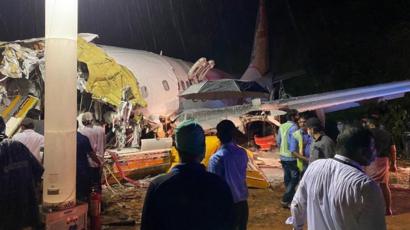
Indian Civil Defence handout photo shoes the wreckage of Flight IX 1134 at Calicut airport (7 August 2020)Image copyrightEPA
Image captionThe plane reportedly overshot the runway upon landing amid heavy rain

The aircraft crashed at 19:40 local time (14:10 GMT) on Friday, as it attempted to land for a second time at Calicut International Airport. The first attempt was aborted by the pilots because of the heavy monsoon-season rainfall lashing Kerala.

India's Civil Aviation Minister, Hardeep Singh Puri, tweeted that the aircraft "overshot the runway in rainy conditions", then plunged down a 35ft (10.6m) slope, before breaking in two.

He said a formal inquiry would be carried out by India's Aircraft Accident Investigation Bureau (AAIB).
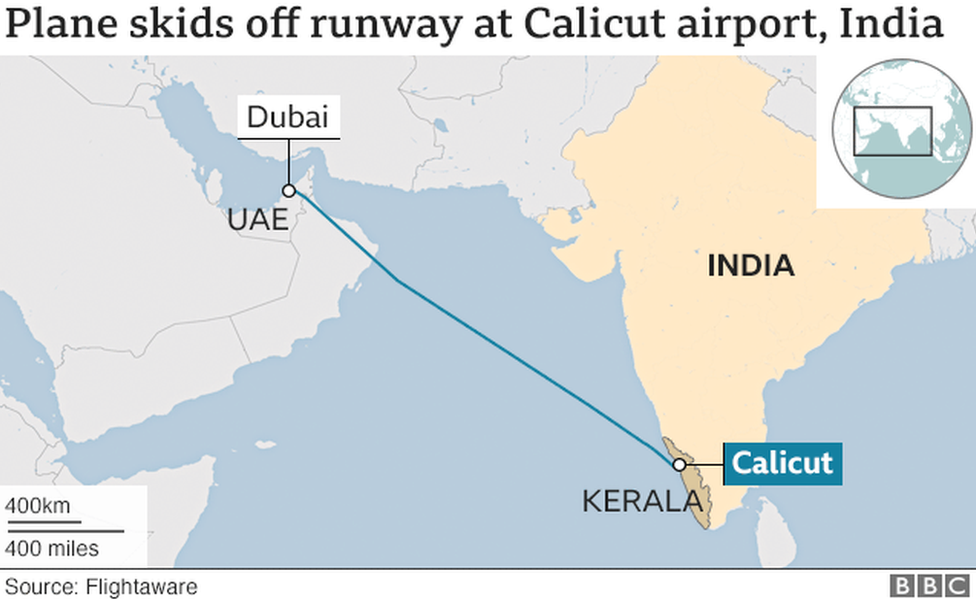

map
Transparent line

The director general of India's National Disaster Response Force, S N Pradhan, said Calicut airport had a "table-top runway" and that the aircraft fell into "a ditch" after skidding across it.

He said the impact with the bottom of the ditch caused the fuselage to break in two, and that the front half was "very badly mangled and damaged".

Mr Puri told broadcaster DD News that first responders were able to rescue the passengers because the plane did not catch fire. Several people had to be cut free.
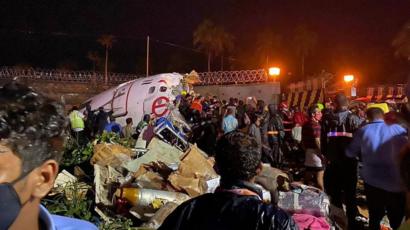
Indian Civil Defence handout photo shoes the wreckage of Flight IX 1134 at Calicut airport (7 August 2020)Image copyrightEPA
Image captionSurvivors have been taken to hospitals in Calicut and Malappuram

At the time of the plane's descent, Kerala was being battered by heavy rains, which are usual in India at this time of year, due to the seasonal monsoon.

Earlier on Friday, dozens of people were feared dead in Kerala's Idukki district after monsoon-season floods triggered a landslide.

What reaction has there been?

Prime Minister Narendra Modi tweeted to express his sympathy for "those who lost their loved ones" in the crash.

Transparent line

Kerala Governor Arif Mohammed Khan said: "Very sad to know of this mishap. All our feelings are with the passengers and their families."

Rahul Gandhi, who is an MP for a district in Kerala, said he was "shocked at the devastating news of the plane mishap in Kozhikode".

Bollywood actors Amitabh Bachchan and Shah Rukh Khan also expressed their condolences, as did India's cricket captain, Virat Kohli.

Transparent line
Transparent lineHave there been similar plane crashes in India?

Plane crashes have happened before during the monsoon season, which lasts from June to September and wreaks havoc across south Asia every year.

In May 2010, 158 people died when an Air India Express flight overshot Mangalore airport runway and crashed.

A similar incident happened in July 2019 in Mangalore, prompting an inquiry, but causing no fatalities.


Karachi# weather #update:# City #expected to receive# 80-130mm #rain #today#

 KARACHI: The Pakistan Meteorological Department on Friday said that the heavy downpour with thunderstorm is expected at any time in Karachi with the city expected to receive between 80-130mm of rainfall today.

According to the Met department, the low air pressure over Rajasthan which will cause the showers, has intensified.

The director of the Met department said that the low air pressure is currently present in Karachi and southern Balochistan. The port city may receive 80 to 130 mm of rainfall with gusty winds which are likely to blow in the city before the rainstorm.

Coronavirus:# Asymptomatic #cases '#carry #same amount of #virus#'

 People with symptomless Covid-19 can carry as much of the virus as those with symptoms, a South Korean study has suggested.

South Korea was able to identify and isolate asymptomatic cases through mass testing as early as the start of March.

There is mounting evidence these cases represent a considerable proportion of coronavirus infections.

But the researchers weren't able to say how much these people actually passed the virus on.

People with a positive coronavirus test were monitored in a community treatment centre, allowing scientists to look at how much of the virus was detectable in their nose and throat swabs.

They were given regular tests, and only released once they were negative.

Results of 1,886 tests suggest people with no symptoms at the time of the test, including those who never go on to develop symptoms, have the same amount of viral material in their nose and throat as people with symptoms.

The study also showed the virus could be detected in asymptomatic people for significant periods of time - although they appeared to clear it from their systems slightly faster than people with symptoms.

The median time (the number where half of cases were higher and half were lower) from being diagnosed to receiving a negative test was 17 days in asymptomatic patients and 19.5 days in symptomatic patients.

Because of the nature of the isolation centre, the study didn't include people with severe cases of the disease. They were also younger and healthier than average.

Banner image reading 'more about coronavirus'


While there was still a risk from people without symptoms, someone with symptoms who was "coughing and spraying out the virus" was likely to be a higher risk, he said.

The risks of catching coronavirus from anyone depended on a number of factors, said infection biologist Dr Andrew Preston from the University of Bath.

That included how deeply and quickly the infected person was breathing, how close you were to them for how long, and whether or not you were in a closed environment, he added.

Climate change: #Lockdown #has 'negligible#' effect on temperatures#

 The dramatic drop in greenhouse gases and air pollutants seen during the global lockdown will have little impact on our warming planet say scientists.

Their new analysis suggests that by 2030, global temperatures will only be 0.01C lower than expected.

But the authors stress that the nature of the recovery could significantly alter the longer term outlook.

A strong green stimulus could keep the world from exceeding 1.5C of warming by the middle of this century.

Previous studies have already established that there were significant changes to greenhouse gas emissions as transport systems shut down around the world in response to the pandemic.

Global daily emissions of CO2 fell by 17% at the peak of the crisis.

The new study builds on these findings by using global mobility data from Google and Apple.

Prof Piers Forster from the University of Leeds, who led the study, worked with his daughter Harriet on the research, when her A-Level exams were cancelled.

With other researchers, they calculated how 10 different greenhouse gases and air pollutants changed between February and June 2020 in 123 countries.

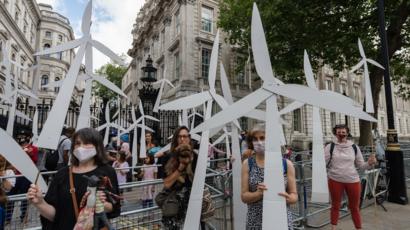
protestsImage copyrightGETTY IMAGES
Image captionProtesters in London calling for more investment in green energy

They found that the drop off peaked in April, with CO2, nitrogen oxides and other emissions falling between 10-30% globally, mainly due to declines in surface transport.

But this new work shows that some of the declines in greenhouse gases actually cancelled each other out in terms of warming.

Nitrogen oxides from transport normally have a warming impact in the atmosphere.

While they went down by 30%, they were matched by a drop in sulphur dioxide, which mainly comes from the burning of coal.

Emissions of this gas help aerosols to form, which reflect sunlight back into space and cool the planet.

This balancing out, combined with the temporary nature of the pandemic restrictions, mean the impact on warming by 2030 will hardly be felt.

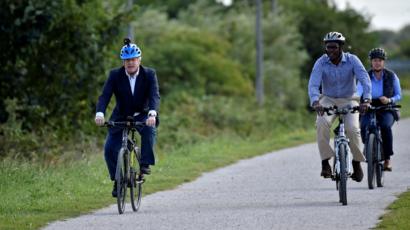
cyclingImage copyrightGETTY IMAGES
Image captionGovernments want to see more people cycling to benefit health and the climate

"Although temporary changes can help, you need to reduce CO2 permanently to make a dent in global warming," said Prof Piers Forster from the University of Leeds.

"CO2 is long lived in the atmosphere, so you effectively need to reduce emissions to zero for a long-time before you begin to cancel out the effects from decades of past emissions."

Harriet Forster, who co-authored the paper with her father, said that while the recent impacts won't last, there is a golden opportunity for governments to change course.

"Our paper shows that the actual effect of lockdown on the climate is small. The important thing to recognise is that we've been given a massive opportunity to boost the economy by investing in green industries - and this can make a huge difference to our future climate," she explained.

Right now, road traffic is still down in many countries say the authors, with the Google data showing all modes of UK transport still 25% or so down, while the official UK government data has cars still 12% down, but with buses and trains running at less than 50%.

The research team says that if transport goes back to what it was, and the world strongly invests in fossil fuels during the recovery, there is a very high probability that the world will go above the 1.5C warming threshold by 2050.

But if the recovery is strongly green, avoids fossil fuel lock-ins and bail outs, and cuts global emissions to net zero by 2050, the world would have around a 55% chance of staying under 1.5C by the middle of the century.

So what needs to be done to help that happen? Study co-author Prof Corinne Le Quéré from the University of East Anglia says there are a number of steps that should now be taken.

"In cities, it is to support cycling and walking (including electric bikes) because this has multiple benefits for climate, for reducing air pollution, and for health," she told BBC News.

"Encouraging remote working until social distancing measures are lifted releases the pressure on public transport, which can continue to be used. As soon as possible all cars will need to be electric."

"The economic stimulus post-Covid could greatly help support that change in the car manufacturing industry towards the production of electric cars alone."

Prof Forster is optimistic that the challenge can be met.

"Disasters are often historically the time of biggest change," he said.

"For once government, industry and public voices are all pretty aligned that green jobs and green investments are the way to build back better."

Beirut explosion: #Anti-government protests #break out in city#

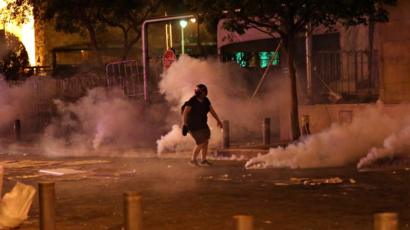
 Protesters clashed with Lebanese security forces at anti-government demonstrations in Beirut on Thursday.

Officers deployed tear gas on dozens of people near parliament.

Demonstrators were angered by Tuesday's devastating blast, which officials say was caused by 2,750 tonnes of ammonium nitrate stored unsafely since 2013.

Many in Lebanon say government negligence led to the explosion, which killed at least 137 people and injured about 5,000 others.

The explosion destroyed entire districts in the capital, with homes and businesses reduced to rubble. Dozens of people are still unaccounted for.

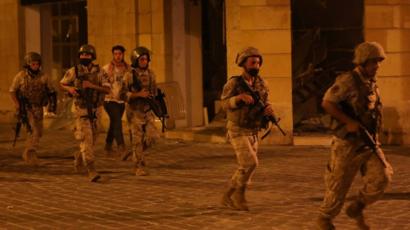
Lebanese security forces at the protestImage copyrightREUTERS
Image captionOfficers deployed tear gas on the small crowd
Protests in BeirutImage copyrightREUTERS
Image captionPeople have blamed government negligence, corruption and mismanagement for the blast

The state news agency says 16 people have been taken into custody as part of an investigation announced by the government this week.

Since the disaster two officials have resigned. MP Marwan Hamadeh stepped down on Wednesday, while Lebanon's ambassador to Jordan Tracy Chamoun stepped down on Thursday, saying the catastrophe showed the need for a change in leadership.

Earlier on Thursday, French President Emmanuel Macron also visited the city and said Lebanon needed to see "profound change" from authorities.

He also called for an international investigation into the disaster.

Media captionAerial footage shows flattened buildings after an explosion in Beirut's port area
line

A city of sirens, empty buildings and empty streets

By Quentin Sommerville, BBC News, Beirut

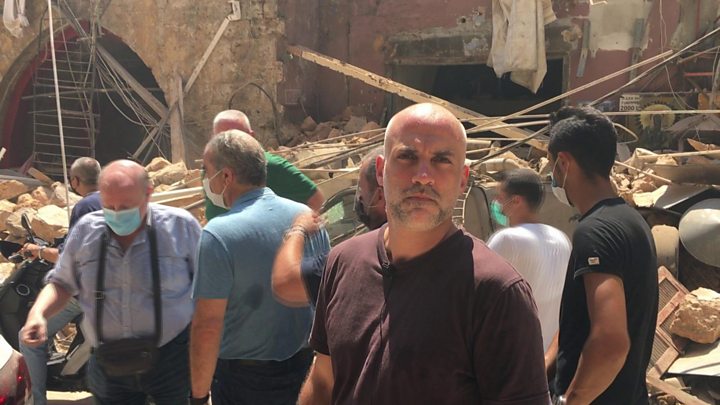
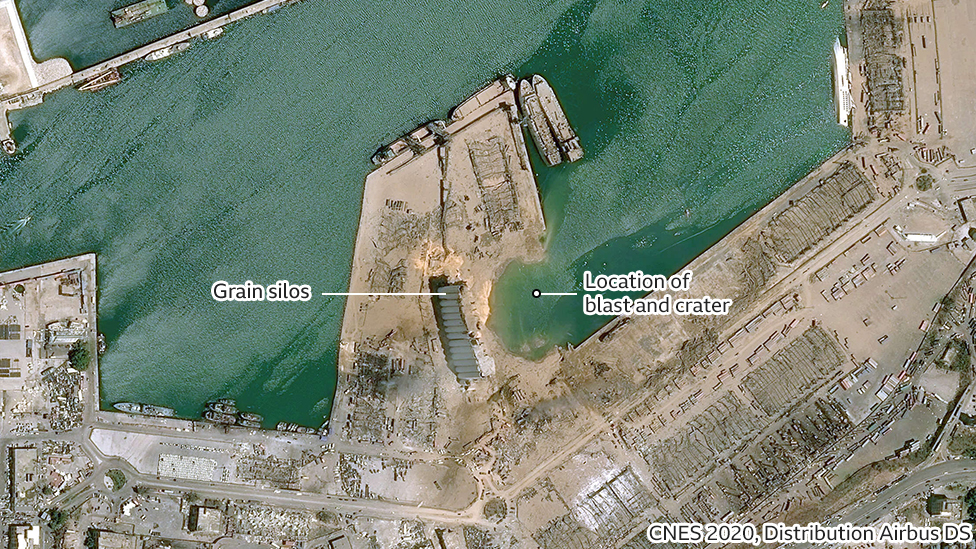
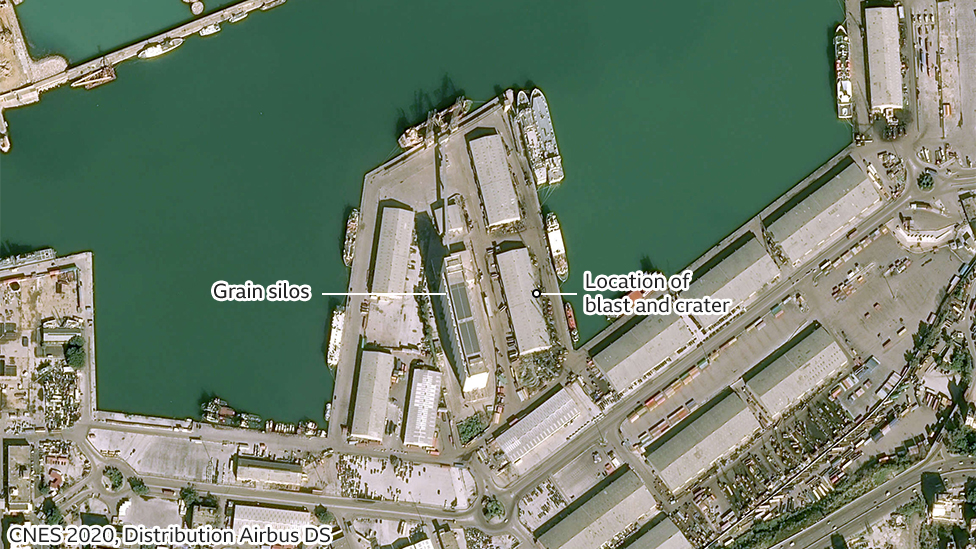
This port was Lebanon's lifeline to the whole world. Something like 80% of the country's grain came through here. The grain silos, which were built way back when, are teetering. Just beyond there I can see a ship listing heavily. I've lived in Beirut for five years and it's almost unrecognisable - it's a city of sirens, of empty buildings, of empty streets.

As I look at the neighbourhood of Gemmayze just behind the port, I can't see a single pane of glass left. Entire roofs have gone - I can see friends' apartments, which are just open to the sky now. All of this area, which was really heavily populated, has been abandoned. No-one is coming back here any time soon.

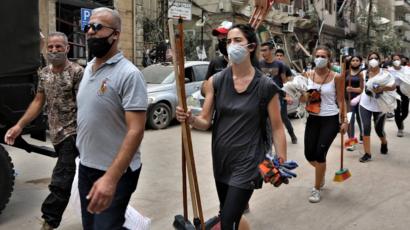
What's really noticeable as you walk the streets here is that every second person seems to have a broom in their hand. There are clear-up teams everywhere, but it's pretty low tech: tiny teams of people with pans and brushes to clean up an an entire city's devastation.

The thing that really strikes me is how enormously stupid it was, what criminal negligence it took to leave this highly explosive material right in the very heart of this city, within yards of people, their homes, their businesses. And the authorities here knew - they had been warned that these chemicals were dangerous and that they were a great risk to Beirut and Lebanon.

line

Where did the ammonium nitrate come from?

In 2013 a Moldovan-flagged ship, the Rhosus, entered Beirut port after suffering technical problems during its journey from Georgia to Mozambique, according to Shiparrested.com, which deals with shipping-related legal cases.

The Rhosus was inspected, banned from sailing onward and was shortly afterwards abandoned by its owners, sparking several legal claims.

Its cargo included the ammonium nitrate, which is used as a fertiliser and as an explosive.

It was stored in a port warehouse for safety reasons, the report said, and it remained there for the next six years.

There are a lot of rules around storing ammonium nitrate, particularly around fire-proofing, because it is so highly explosive if it comes into contact with flames.

Media captionRami Ruhayem has been to Gemmayze, the closest residential area to the port

The head of the port and the head of the customs authority said that they had written to the judiciary several times asking that the chemical be exported or sold on to ensure port safety.

Port General Manager Hassan Koraytem told OTV they had been aware that the material was dangerous when a court first ordered it stored in the warehouse, "but not to this degree".

line
  • line

Is there any hope of finding survivors?

Rescuers are continuing to search for people in Beirut, and security forces have sealed off a wide area around the blast site.

On Thursday, two days after the explosion, a French rescue team working in the city said there was still a good chance of finding survivors.

One unnamed rescuer told Mr Macron during his visit that they hoped to find a group of seven or eight people believed to be trapped in a "control room" under the rubble.

INTERACTIVESee extent of damage at Beirut blast site

5 August 2020

Beirut port in August 2020 after explosion

25 January 2020

Beirut port in January 2020

Meanwhile, Beirut's hospitals are feeling the strain of so many people needing medical care. Public Health Minister Hamad Hassan said Lebanon's health sector was short of beds, and lacked the equipment necessary to treat the injured and those in critical condition.

Beirut's governor Marwan Aboud also warned that as many as 300,000 people have been left homeless by the blast.

Volunteers cleaning the streets of BeirutImage copyrightEPA
Image captionPeople in Beirut have been volunteering to clean up the rubble

Lebanon also imports most of its food. Because large quantities of grain stored in the port have been destroyed, there are fears that the country will face widespread food insecurity. The future of the port itself is in doubt too.

RAF Lossiemouth jets scrambled to Russian aircraft

  RAF jets were scrambled to intercept four Russian military aircraft to the north of Scotland. Typhoons from RAF Lossiemouth in Moray and a...