ads

Monday, November 9, 2020

US election: Joe Biden backs Covid vow with new task force


Biden supporter Elise, nine, in New YorkIMAGE COPYRIGHTEPA
image captionCovid-19 in the US is nearing 50 million cases and Joe Biden says tackling the pandemic is his main priority

US President-elect Joe Biden has named the members of his coronavirus task force, highlighting his pledge to make tackling Covid-19 his top priority.

Mr Biden said one of his "most important battles" was to manage the surge in cases and bring a safe and viable vaccine to the people.

He is also forging ahead on transition issues from climate change to migrants.

But President Trump still refuses to concede and is backing legal challenges to results in several key states.

Mr Biden's victory was declared on Saturday but it remains a projection, with a number of states still counting votes. The nationwide difference in votes for the two candidates is about 4.5 million.

Mr Biden and Vice-President-elect Kamala Harris have launched a website for the transition, saying the team will also focus on the economy and tackling racism.

But the president-elect will need the help of an agency called the General Services Administration to begin the transition process and its Trump-appointed head has given no indication when that will happen,

What are the Covid plans?

In his first appointments since his victory was announced, he named three co-chairs and 10 members. Among the co-chairs named is Vivek Murthy, who was appointed US surgeon-general by President Barack Obama in 2014 and removed by President Trump in 2017.

media captionBiden and Harris call for unity in victory speeches

One member is immunologist Rick Bright, who says he was ignored and then removed by the Trump administration over his early warnings on Covid.

In a statement, Mr Biden said the board would help to get the virus under control, deliver relief for working families, address racial disparities and work to reopen schools and businesses.

He also said it would "elevate the voices of scientists and public health experts". President Trump's comments on Covid-19 have often conflicted with scientists, including leading infectious disease expert Anthony Fauci.

Mr Biden on Monday also welcomed the news from Pfizer and BioNTech that preliminary analysis showed their vaccine in development could prevent more than 90% of people from getting Covid-19.

He thanked the "brilliant women and men who helped produce this breakthrough and to give us such cause for hope" but also warned it was "important to understand that the end of the battle against Covid-19 is still months away".

The focus of his policy will be on mask wearing, social distancing, contact tracing and hand washing.

Covid cases in the US since the epidemic began are nearing 10 million, and there have been more than 237,000 deaths recorded so far, Johns Hopkins research shows.

Donald Trump also welcomed the vaccine statement, tweeting that it was "such great news".

What are the other transition plans?

They reportedly include a slew of executive orders - written orders issued by the president to the federal government that do not require congressional approval - aimed at reversing controversial Trump policies. They are in draft form and cannot be issued until he takes office. According to US media:

  • Mr Biden will rejoin the Paris climate agreement, which the US officially left on Wednesday
  • He will reverse the decision to withdraw from the World Health Organization
  • He will end the travel ban on citizens from seven mostly Muslim countries
  • He will reinstate an Obama-era policy of granting immigration status to undocumented migrants who entered the US as children

Mr Biden also aims to make addressing racism a key policy, including better access to affordable housing for black and minority communities.

media captionA look back at Joe Biden's life and political career

Mr Biden wants to transform US policing, including banning the use of chokeholds, and to reduce the US prison population, which at more than two million people is the biggest in the world.

However, for the transition process to begin, the support of the General Services Administration is needed to access government funds and communicate with the federal agencies it will be staffing.

Its administrator, Emily Murphy, has not started the process nor indicated when she will do so, sparking concern among some Democrats that Mr Trump will try to impede the transition process.

What have Mr Trump and Republicans said?

The vast majority of the president's tweets have continued to call the electoral process into question.

Mr Trump, the first president to lose a re-election bid since 1992, has launched an array of lawsuits backing claims of fraud for which no evidence has yet been presented.

One of his lawyers, Rudy Giuliani, on Monday said there were "unlawful votes" in Pennsylvania, Michigan, Georgia, Wisconsin and Nevada. "We will prove it all," he said.

media caption"My message to Republican friends"

Mr Trump still plans rallies to back his challenge, campaign spokesman Tim Murtaugh said.

Most Republicans have remained silent on Mr Biden's projected election victory, favouring the unveiling of full results.

The Republican leader in the House of Representatives, Kevin McCarthy, told Fox News that all recounts and legal challenges should be completed.

The New York Times said advisers had told Mr Trump the chances of legal success were not high but that he was not yet ready to accept the loss.

Mr Trump has vowed to take legal action as far as the Supreme Court.

If the election result is challenged, it would require legal teams to argue this in state courts. State judges would then need to uphold the challenge and order a recount, and Supreme Court justices could then be asked to overturn a ruling.

Former President George W Bush was one Republican who did congratulate Mr Biden, calling him a "good man".

What happens next?

Votes in some states continue to be counted and results are never official until final certification, which occurs in each state in the weeks following the election.

This must be done before 538 chosen officials (electors) from the Electoral College - which officially decides who wins the election - meet in their state capitals to vote on 14 December.

media captionWho is Kamala Harris, vice-president-elect?

The electors' votes usually mirror the popular vote in each state. However, in some states this is not a formal requirement.

The new president is officially sworn into office on 20 January after a transition period to give them time to appoint cabinet ministers and make plans.

The handover of power takes place at a ceremony known as the inauguration, which is held on the steps of the Capitol building in Washington DC.

Covid vaccine: First 'milestone' vaccine offers 90% protection


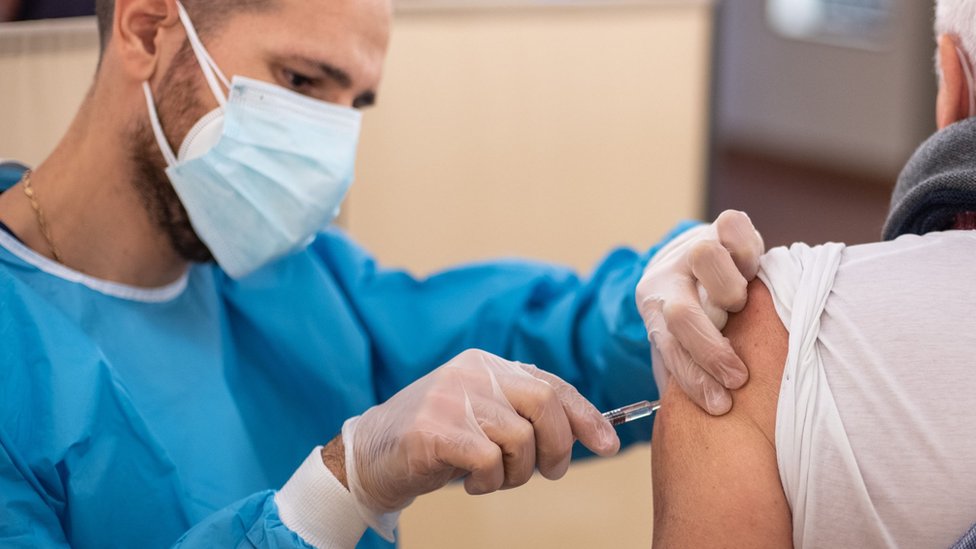
Person getting vaccineIMAGE COPYRIGHTGETTY IMAGES

The first effective coronavirus vaccine can prevent more than 90% of people from getting Covid-19, a preliminary analysis shows.

The developers - Pfizer and BioNTech - described it as a "great day for science and humanity".

Their vaccine has been tested on 43,500 people in six countries and no safety concerns have been raised.

The companies plan to apply for emergency approval to use the vaccine by the end of the month.

No vaccine has gone from the drawing board to being proven highly effective in such a short period of time.

There are still huge challenges ahead, but the announcement has been warmly welcomed with scientists describing themselves smiling "ear to ear" and some suggesting life could be back to normal by spring.

"I am probably the first guy to say that, but I will say that with some confidence," said Sir John Bell, regius professor of medicine at Oxford University.

How effective could it be?

A vaccine - alongside better treatments - is seen as the best way of getting out of the restrictions that have been imposed on all our lives.

The data shows that two doses, three weeks apart, are needed. The trials - in US, Germany, Brazil, Argentina, South Africa and Turkey - show 90% protection is achieved seven days after the second dose.

However, the data presented is not the final analysis as it is based on only the first 94 volunteers to develop Covid so the precise effectiveness of the vaccine may change when the full results are analysed.

Dr Albert Bourla, the chairman of Pfizer, said: "We are a significant step closer to providing people around the world with a much-needed breakthrough to help bring an end to this global health crisis."

Prof Ugur Sahin, one of the founders of BioNTech, described the results as a "milestone".

media captionSarah Montague reacted with excitement upon hearing Professor Bell's views on the significance of today's vaccine news

When will the vaccine be available?

A limited number of people may get the vaccine this year.

Pfizer and BioNTech say they will have enough safety data by the third week of November to take their vaccine to regulators.

Until it has been approved it will not be possible for countries to begin their vaccination campaigns.

The two companies say they will be able to supply 50 million doses by the end of this year and around 1.3 billion by the end of 2021. Each person needs two doses.

The UK should get 10 million doses by the end of the year, with a further 30 million doses already ordered.

Who would get it?

Not everyone will get the vaccine straight away and countries are each deciding who should be prioritised.

Hospital staff and care home workers will be near the top of every list because of the vulnerable people they work with, as will the elderly who are most at risk of severe disease.

The UK is likely to prioritise older resident in care homes and the people that work there.

But it says a final decision has not been made, saying it will depend on how well the vaccine works in different age-groups and how the virus is spreading.

People under 50 and with no medical problems are likely to be last in the queue.

Are there any potential problems?

There are still many unanswered questions as this is only interim data.

We do not know if the vaccine stops you spreading the virus or just from developing symptoms. Or if it works equally well in high-risk elderly people.

The biggest question - how long does immunity last - will take months or potentially years to answer.

There are also massive manufacturing and logistical challenges in immunising huge numbers of people, as the vaccine has to be kept in ultra-cold storage at below minus 80C.

The vaccine appears safe from the large trials so far but nothing, including paracetamol, is 100% safe.

How does it work?

There are around a dozen vaccines in the final stages of testing - known as a phase 3 trial - but this is the first to show any results.

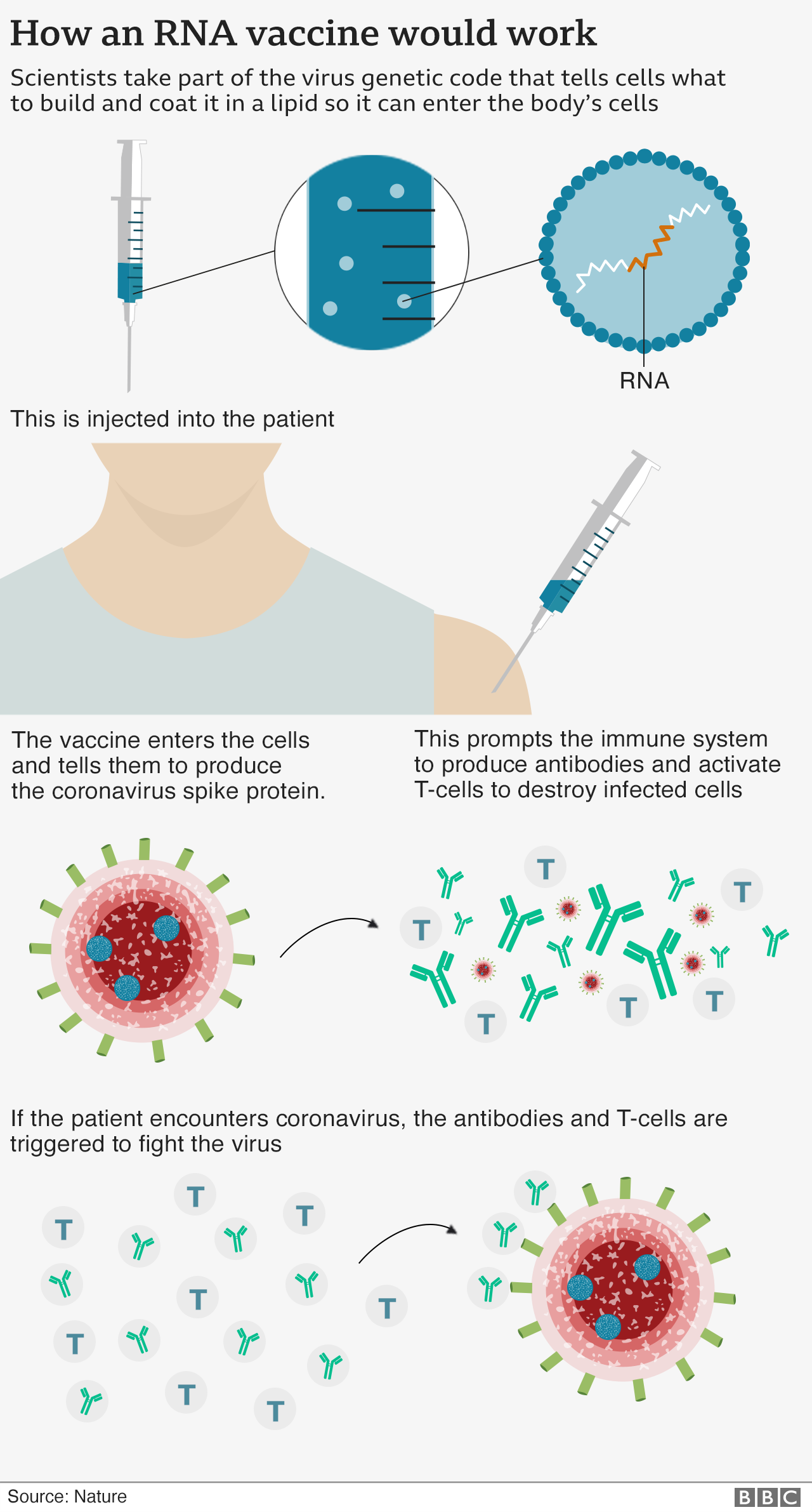
It uses a completely experimental approach - that involves injecting part of the virus's genetic code - in order to train the immune system.

Previous trials have shown the vaccine trains the body to make both antibodies - and another part of the immune system called T-cells to fight the coronavirus.

BBC graphic

What has the reaction been?

The UK's chief medical advisor Prof Chris Whitty said the results showed the "power of science" and was a "reason for optimism" for 2021.

The US president-elect Joe Biden said it was "excellent news".

"It is also important to understand that the end of the battle against Covid-19 is still months away," he added.

The UK Prime Minister's official spokesman said the results were "promising" and that "the NHS stands ready to begin a vaccination programme for those most at risk once a Covid-19 vaccine is available".

Prof Peter Horby, from the University of Oxford, said: "This news made me smile from ear to ear.

"It is a relief... there is a long long way to go before vaccines will start to make a real difference, but this feels to me like a watershed moment."

Thursday, August 13, 2020

New Zealand has reported 14 new Covid-19 cases a day after its biggest city, Auckland, went back into lockdown. The detection of four new infected family members earlier this week shocked a country that had recorded no locally transmitted cases for more than three months. Of the new cases, 13 have been linked back to this family, while one is an overseas arrival who was in quarantine. A three-day lockdown was imposed in Auckland on Wednesday. "We can see the seriousness of the situation we are in," Prime Minister Jacinda Ardern said in a news conference.

 The US government has proposed changing the definition of a showerhead to allow increased water flow, following complaints from President Donald Trump about his hair routine.

Under a 1992 law, showerheads in the US are not allowed to produce more than 2.5 gallons (9.5l) of water per minute.

The Trump administration wants this limit to apply to each nozzle, rather than the overall fixture.

Consumer and conservation groups argue that it is wasteful and unnecessary.

The changes were proposed by the Department of Energy on Wednesday following complaints by Mr Trump at the White House last month.

"So showerheads - you take a shower, the water doesn't come out. You want to wash your hands, the water doesn't come out. So what do you do? You just stand there longer or you take a shower longer? Because my hair - I don't know about you, but it has to be perfect. Perfect," he said.

Andrew deLaski, executive director of the energy conservation group Appliance Standards Awareness Project, said the proposal was "silly".

With four or five or more nozzles, "you could have 10, 15 gallons per minute powering out of the showerhead, literally probably washing you out of the bathroom," he told the Associated Press news agency.

"If the president needs help finding a good shower, we can point him to some great consumer websites that help you identify a good showerhead that provides a dense soak and a good shower," he added.

RAF Lossiemouth jets scrambled to Russian aircraft

  RAF jets were scrambled to intercept four Russian military aircraft to the north of Scotland. Typhoons from RAF Lossiemouth in Moray and a...