ads

Wednesday, November 11, 2020

Hong Kong pro-democracy lawmakers resign after China ruling


media captionWu Chi-wai, Hong Kong pro-democracy lawmaker 'announces mass resignations'

All of Hong Kong's pro-democracy lawmakers have announced their resignation after Beijing forced the removal of four of their colleagues.

On Wednesday Beijing passed a resolution allowing the city's government to dismiss politicians deemed a threat to national security.

The opposition lawmakers then said they would leave in solidarity.

For the first time since Hong Kong was handed back to China in 1997 the body has almost no dissenting voices.

BBC China correspondent Stephen McDonnell says the legislature was already stacked in favour of the pro-Beijing camp.

The dismissal of the four legislators is viewed by many as the latest attempt by China to restrict Hong Kong's freedoms - something Beijing denies.

Democratic Party chairman Wu Chi-wai told reporters following the lawmakers' removal: "We can no longer tell the world that we still have 'one country, two systems', this declares its official death."

media captionPro-democracy lawmaker Claudio Mo: "They are forcing us to quit"

Hong Kong - formerly a British colony - was returned to China under the "one country, two systems" principle, which allowed it to retain more rights and freedoms than the mainland until 2047.

But in late June China passed a controversial, far-reaching national security law in the territory after years of pro-democracy and anti-Beijing protests, which reduced Hong Kong's autonomy and made it easier to punish demonstrators.

Why did the lawmakers resign?

The city's pro-democracy legislators had 19 seats in the 70-seat legislature. All those members have now left - either by resigning or by being dismissed.

The new resolution passed by China's National People's Congress Standing Committee on Wednesday says that lawmakers should be disqualified if they support Hong Kong independence, refuse to acknowledge China's sovereignty, ask foreign forces to interfere in the city's affairs or in other ways threaten national security.

media captionPro-Beijing lawmaker Michael Tien says China needed to take action to allow Hong Kong's legislature to function

It also allows the Hong Kong government to directly remove lawmakers without having to approach the courts.

Moments after that resolution passed, four lawmakers - Alvin Yeung, Kwok Ka-ki and Dennis Kwok of the Civic Party and Kenneth Leung of the Professionals Guild - were dismissed.

All four of them are considered moderates and they have never supported Hong Kong independence.

"If observing due process and fighting for democracy can lead to being disqualified, it [disqualification] will be my honour," Dennis Kwok said.
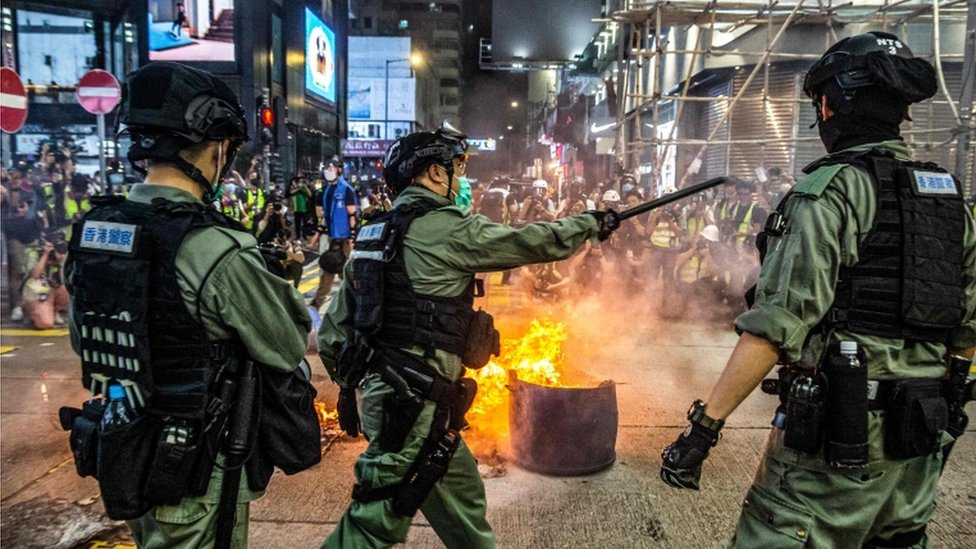
Police deter pro-democracy protesters from blocking roads in the Mong Kok district of Hong Kong on May 27, 2020IMAGE COPYRIGHTAFP
image captionCritics warn the law will shut down dissent

"We... will stand with our colleagues who are disqualified. We will resign en masse," Wu Chi-wai said. The 15 lawmakers' letter of resignation will be submitted on Thursday.

Chinese foreign ministry spokesman Wang Wenbin said the disqualification of the four lawmakers was "rational, reasonable and in line with the constitution and laws".

"This was a necessary requirement for adhering to and improving on 'one country, two systems,' implementing Hong Kong's Basic Law, as well as Hong Kong's National Security Law," he said at a news conference in Beijing.

But others have criticised the move. UK Foreign Secretary Dominic Raab called the Chinese resolution "a further assault on Hong Kong's high degree of autonomy and freedoms under the UK-China Joint Declaration".

"This campaign to harass, stifle and disqualify democratic opposition tarnishes China's international reputation and undermines Hong Kong's long-term stability."

Human rights organisation Amnesty International has also condemned the resolution. "Bulldozing through arbitrary decisions via the Chinese government makes a mockery of the rule of law," Asia-Pacific regional director Yamini Mishra said.
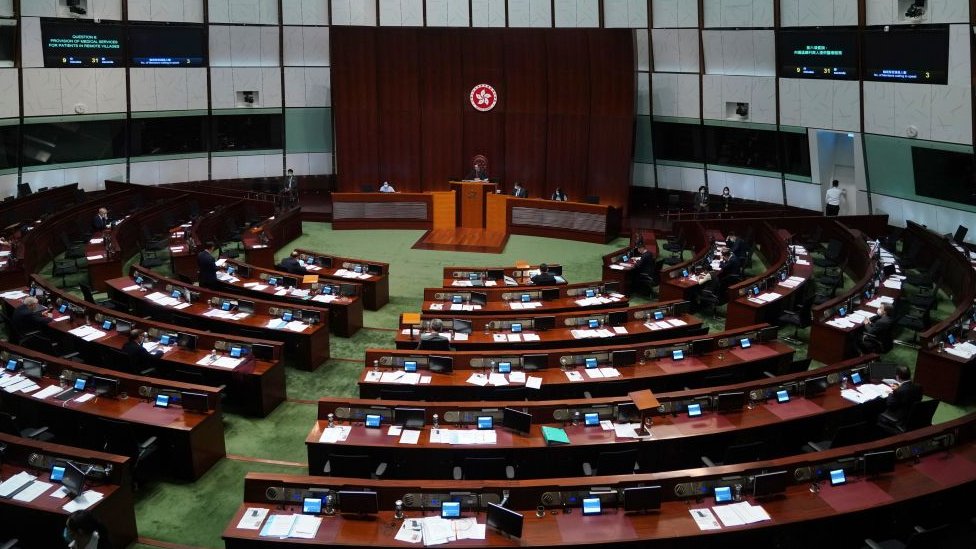
Legislators attend a Legislative Council (LegCo) meeting on November 4, 2020 in Hong Kong, China.IMAGE COPYRIGHTGETTY IMAGES
image captionChief Executive Carrie Lam said opinions in the legislature had to be expressed "in a responsible manner"

The territory's leader, Chief Executive Carrie Lam, is pro-Beijing and is supported by the central government there.

Speaking to the media, Ms Lam said the four council members who were disqualified had already failed to meet the requirements to stand in the now postponed elections next year.

She added that although she "welcomes diverse opinions in the Legislative Council" these had to be expressed "in a responsible manner".

South China Morning Post newspaper quoted Ms Lam as saying no by-elections would be held in the four now vacant seats as legislative elections were only nine months away.

Analysis box by Stephen McDonell, China correspondent

The Chinese government and its surrogates in Carrie Lam's administration have - in recent times - used specific problems as a series of excuses to introduce wholesale, Draconian changes which will remain in place long after whatever hurdle it is has been cleared.

In this case, four legislators had, controversially, been ruled ineligible for the next Legislative Council election.

However, because the term of the current legislature had been extended for a year, due to a delayed vote, they had been able to remain in their existing positions.
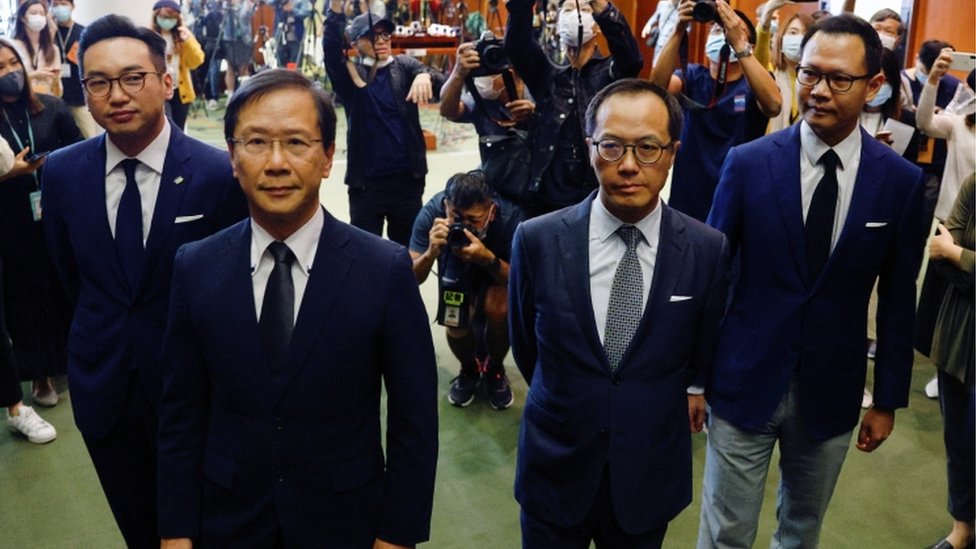
Alvin Yeung Ngok-kiu, Kwok Ka-ki, Kenneth Leung and Dennis KwokIMAGE COPYRIGHTREUTERS
image captionThe four lawmakers after they were removed

Carrie Lam wanted them gone straight away so she says she asked Beijing to introduce a new law enabling their immediate dismissal.

In reality, who knows whether Hong Kong's leader requested this move or was told it was going to happen by the Communist Party's senior leadership?

Either way, now the city government has been empowered to remove any pro-democracy politician who is seen to have acted with insufficient loyalty to the motherland in the future.

Crucially, the courts can be bypassed under the new rules and, now that the Hong Kong government has said that the concept of the separation of powers has never actually applied in the city, the executive branch is able to dismiss members of the legislature and their view is that this is not really anything to worry about.

Presentational grey line

What's been happening in Hong Kong?

As a Special Administrative Region, Hong Kong was to have its own legal system, multiple political parties, and rights including freedom of assembly and free speech.

But the new security law for the city passed in response to months of pro-democracy protests criminalised "secession, subversion and collusion with foreign forces".

Beijing said the law will return stability to the territory, but critics said it effectively curtails freedom of speech and protest.

After the introduction of the security law the UK offered Hong Kong residents still holding British National Overseas (BNO) status a route to British citizenship.

Around 300,000 people currently hold BNO passports, while an estimated 2.9 million people born before the handover are eligible for one.

China last month strongly criticised the UK in response, telling London to "immediately correct its mistakes".

Monday, November 9, 2020

Virgin Hyperloop pod transport tests first passenger journey


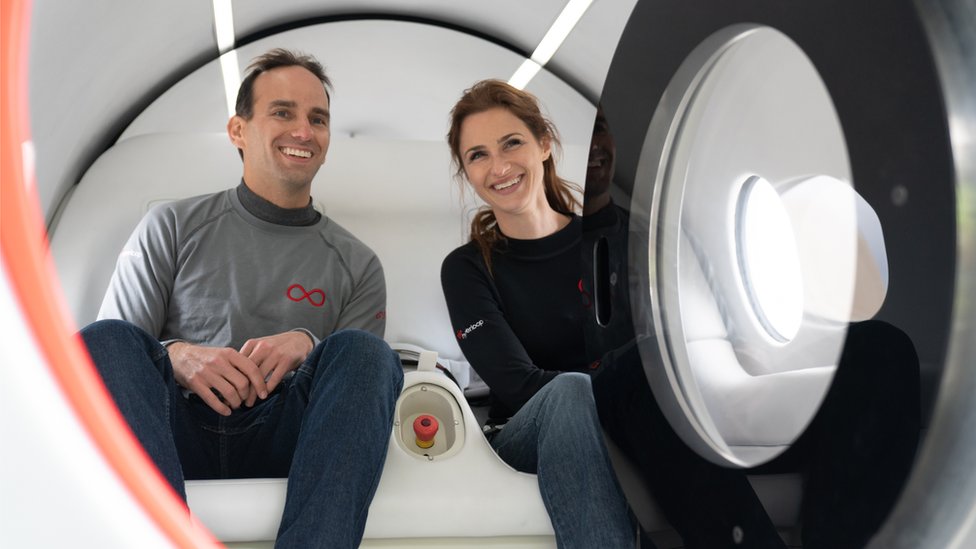
Sara Luchian and Josh Giegel inside their podIMAGE COPYRIGHTVIRGIN HYPERLOOP
image captionTrial passengers Sara Luchian and Josh Giegel - who both work at Virgin Hyperloop - inside their pod

Virgin Hyperloop has trialled its first ever journey with passengers, in the desert of Nevada.

The futuristic transport concept involves pods inside vacuum tubes carrying passengers at high speeds.

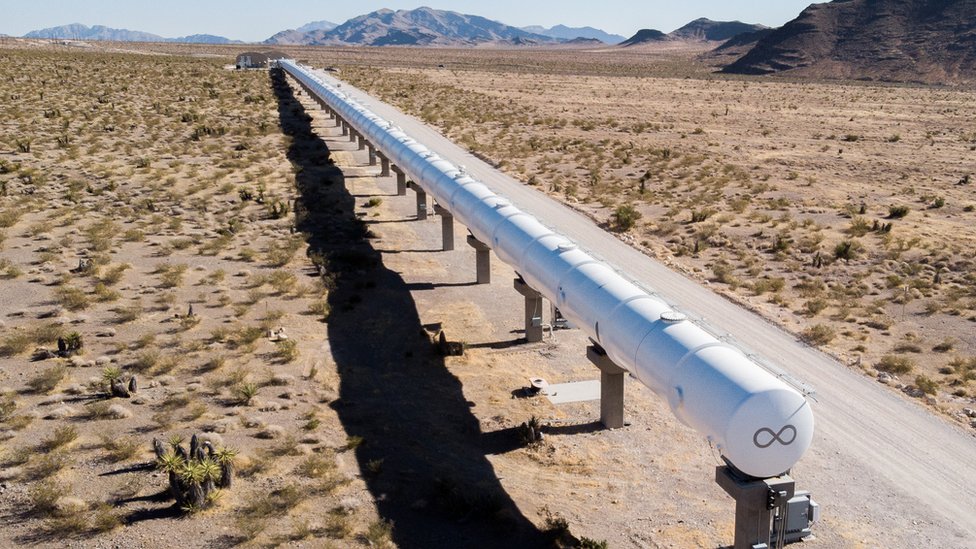
In the trial, two passengers - both company staff - travelled the length of a 500m test track in 15 seconds, reaching 107mph (172km/h).

However, this is a fraction of Virgin's ambitions for travel speeds of more than 1,000km/h.

Virgin Hyperloop is not the only firm developing the concept but nobody has carried passengers before.

Sara Luchian, director of customer experience, was one of the two on board and described the experience as "exhilarating both psychologically and physically" to the BBC shortly after the event.

She and chief technology officer Josh Giegel wore simple fleeces and jeans rather than flights suits for the event, which took place on Sunday afternoon outside of Las Vegas. Ms Luchian said the journey was smooth and "not at all like a rollercoaster" although the acceleration was "zippier" than it would be with a longer track. Neither of them felt sick, she added.

She said that their speed was hampered by the length of the track and acceleration required.

Virgin Hyperloop test track in NevadaIMAGE COPYRIGHTVIRGIN HYPERLOOP
image captionThe Virgin Hyperloop test track in the Nevada desert

The concept, which has spent years in development, builds on a proposal by Tesla founder Elon Musk. Some critics have described it as science fiction.

It is based on the world's fastest magnetic levitation (maglev) trains, then made faster by speeding along inside vacuum tubes.

The Maglev train speed world record was set in 2015 when a Japanese train reached 374mph in a test run near Mount Fuji.

Founded in 2014, Virgin Hyperloop received investment from the Virgin Group in 2017. It was previously known as Hyperloop One and Virgin Hyperloop One.

In a BBC interview in 2018, then Virgin Hyperloop One boss Rob Lloyd, who has since left the firm, said the speed would in theory enable people to travel between Gatwick and Heathrow airports, 45 miles apart on opposite sides of London, in four minutes.

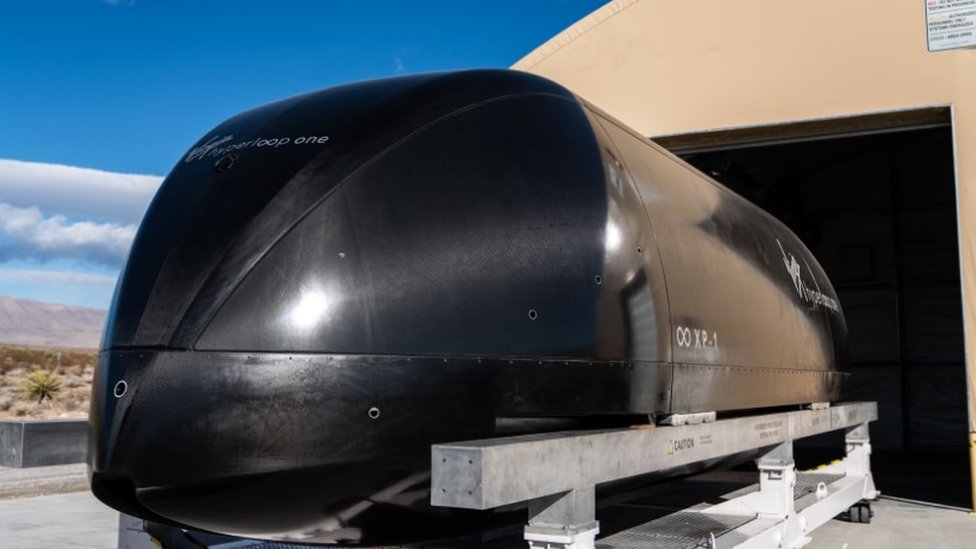
Virgin Hyperloop podIMAGE COPYRIGHTVIRGIN HYERLOOP
image captionVirgin says the pods could reach speeds of over 1,000km/h

Los Angeles-based Virgin Hyperloop is also exploring concepts in other countries, including a hypothetical 12 minute connection between Dubai and Abu Dhabi, which takes more than an hour by existing public transport.

Critics have pointed out that Hyperloop travel systems would involve the considerable undertaking of both getting planning permission and then constructing vast networks of tubes for every travel path.

Ms Luchian acknowledges the potential difficulties, saying: "Of course there's a lot of infrastructure to be built but I think we've mitigated a lot of risk that people didn't think was possible."

She added: "Infrastructure is such an important focus for so many people in government. We know people are looking for solutions. They're looking for the transportation of the future. We can keep building today's or yesterday's transport systems and keep encountering the same problems they bring or we can really look to build something that solves those problems."

Covid: Have we finally got a coronavirus vaccine?


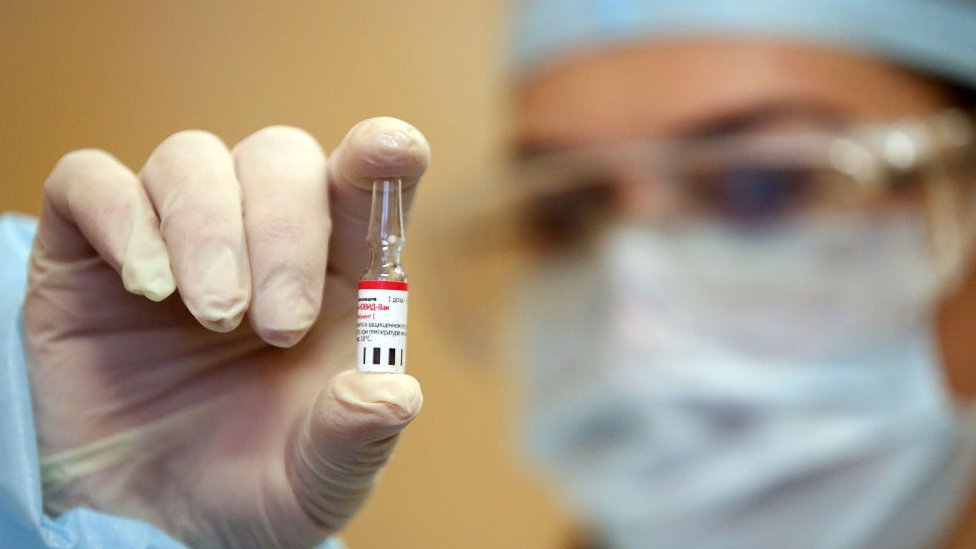
A person holding an ampouleIMAGE COPYRIGHTGETTY IMAGES

The quest for an effective vaccine against Covid-19 has seen a significant step forward, with the announcement of "milestone" results.

Preliminary findings show a vaccine developed by Pfizer and BioNTech can prevent more than 90% of people from getting Covid-19.

What have Pfizer/BioNTech achieved?

They are the first to share data from the final stages of testing - known as a phase 3 trial.

This is a crucial point in vaccine development, where some experimental vaccines will fail.

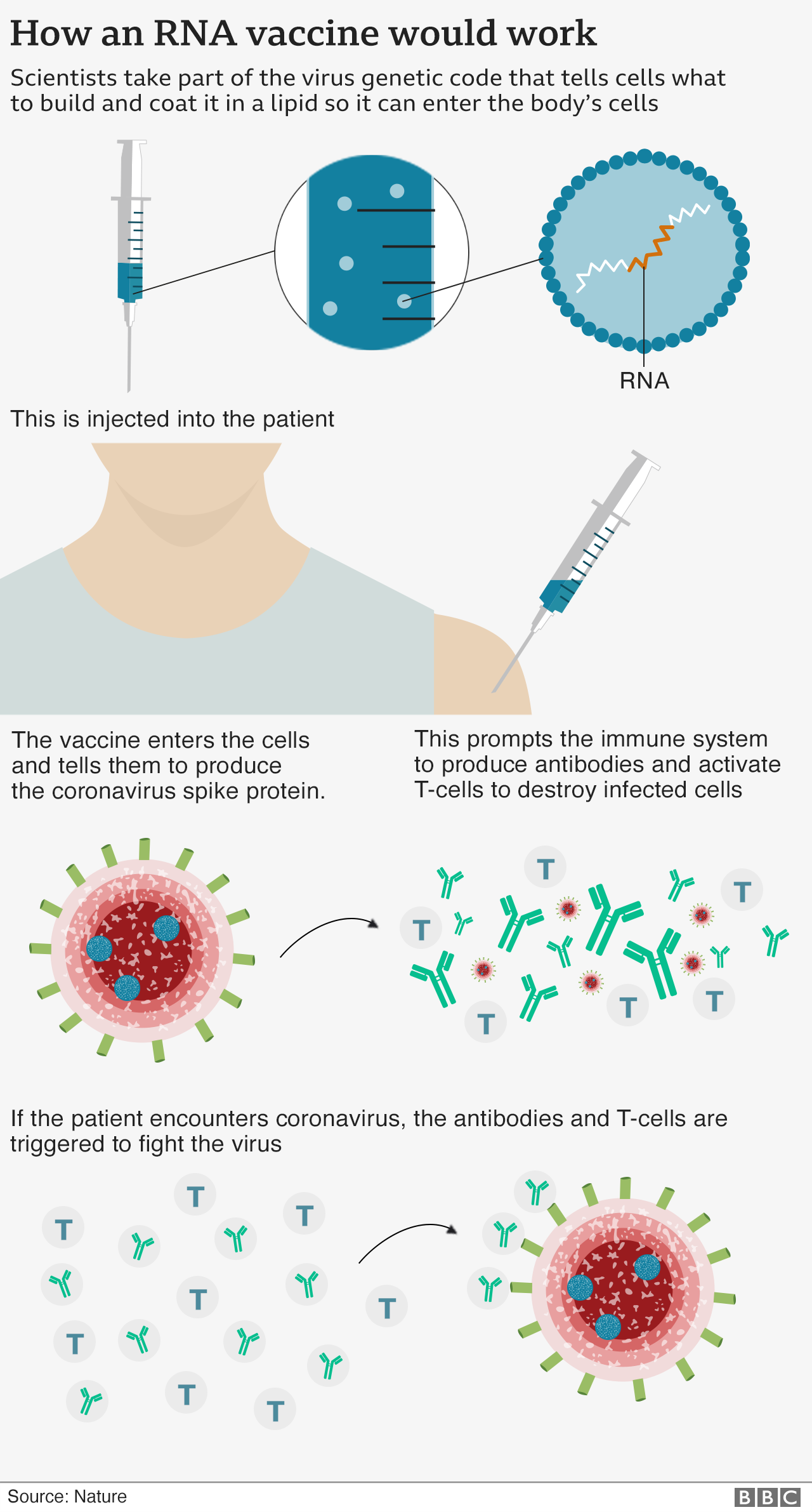
The vaccine uses a completely experimental approach, which involves injecting part of the virus's genetic code into people, in order to train the immune system.

About 43,000 people have been given the vaccine, and no safety concerns have been raised.

BBC graphic

So when will the vaccine become available?

Pfizer believes it will be able to supply 50 million doses by the end of this year, and around 1.3 billion by the end of 2021.

The UK should get 10 million doses by the end of 2020, with a further 30 million doses already ordered.

Exactly who will be immunised first will depend on where Covid is spreading when the vaccine becomes available and in which groups it is most effective.

The UK has not decided, for example, how to prioritise health and care workers who work with the most vulnerable people, relative to those most at risk if they catch the disease.

In broad terms, the over-80s, care home residents and health or care workers will be near the top of the list.

Age is, by far, the biggest risk factor for Covid, so the older you are, the sooner you are likely to be vaccinated.

Most experts think the vaccine will not be widely available until the middle of 2021.

RAF Lossiemouth jets scrambled to Russian aircraft

  RAF jets were scrambled to intercept four Russian military aircraft to the north of Scotland. Typhoons from RAF Lossiemouth in Moray and a...