ads

Wednesday, November 11, 2020

Coronavirus: New York imposes measures in 'last chance' against new wave


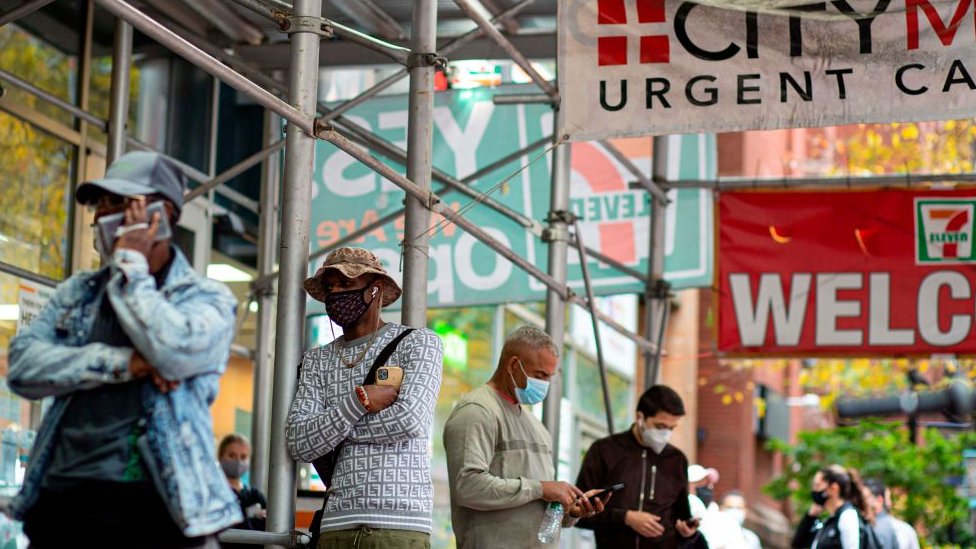
Late-night gatherings have been identified as a key source of infection spread in New YorkIMAGE COPYRIGHTGETTY IMAGES
image captionLate-night gatherings have been identified as a key source of infection spread in New York

New York has introduced new restrictions aimed at curbing coronavirus, with Mayor Bill de Blasio warning it was the city's "last chance" to stop a second wave.

Bars, restaurants and gyms must close by 22:00 and people can only meet in groups of 10 or less.

The US is seeing a surge in coronavirus - a record 61,964 Americans were in hospital on Tuesday.

An average of over 900 people a day are now dying with the disease.

More than a million new cases in November pushed the total confirmed cases to over 10 million nationally with 239,732 deaths so far.

The US has been seeing more than 100,000 new cases per day over the last 10 days in what experts say may be a worse outbreak than those seen in the spring and summer.

Experts warn hospitals across the country could soon be overwhelmed.

On Wednesday a member of President-elect Joe Biden's Covid-19 advisory panel said a four to six week lockdown could bring the pandemic under control.

Dr Michael Osterholm said that the government could borrow enough money to cover lost income for businesses during a shutdown.

What's happening in New York?

"We're seeing a national and global Covid surge, and New York is a ship on the Covid tide," state Governor Andrew Cuomo said on Wednesday.

New measure come into effect on Friday affecting hospitality after Mr Cuomo said contact tracing identified late-night gatherings as key virus spreaders in the state.

If the rate of spread of infection continued to rise, Mayor Blasio said the New York City's public school system would close and children would begin online classes.

"This is our last chance to stop a second wave. We can do it, but we have to act now," Mr de Blasio tweeted.

New York City was badly hit by the virus earlier this year when nearly 18,000 people died with Covid-19 in March, April and May, according to the city's Department of Health and Mental Hygiene.

What's the picture nationwide?

States across the US have broken new case records this week. On 10 November, Texas became the first state to hit one million total cases. If Texas were a separate country, it would rank 11th in the world for most cases.

Other states, including Illinois, Wisconsin, Minnesota, California and Florida, have also seen numbers rise. CBS News reports 15 states saw the numbers of patients in hospital due to the virus double in the last month.

Some hospitals, such as in Idaho and Missouri, have had to turn patients away because they ran out of room.
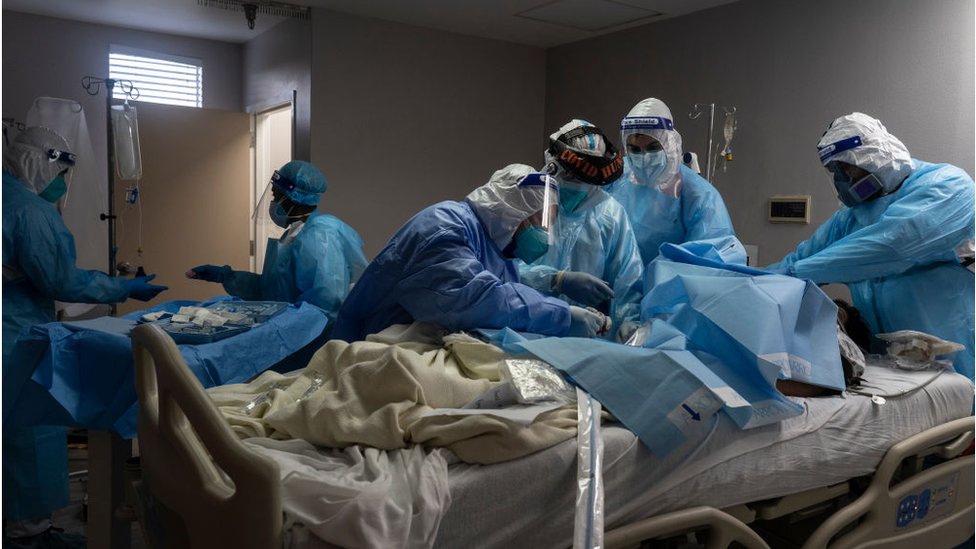
Houston, Texas, hospital Covid wardIMAGE COPYRIGHTGETTY IMAGES
image captionHospital staff treat a Covid patient in Houston, Texas

State leaders have been re-imposing pandemic restrictions as a result. Residents of Wisconsin and Nevada have been urged to stay at home for two weeks. In Minnesota, bars and restaurants must shut by 22:00.

On Tuesday, Mr Osterholm warned of a "perfect storm". Speaking to the CBS This Morning programme, Mr Osterholm said there was "no question that our hospitals are about to be overrun". He noted "the darkest days of this pandemic between now and next spring", before the vaccine arrives.
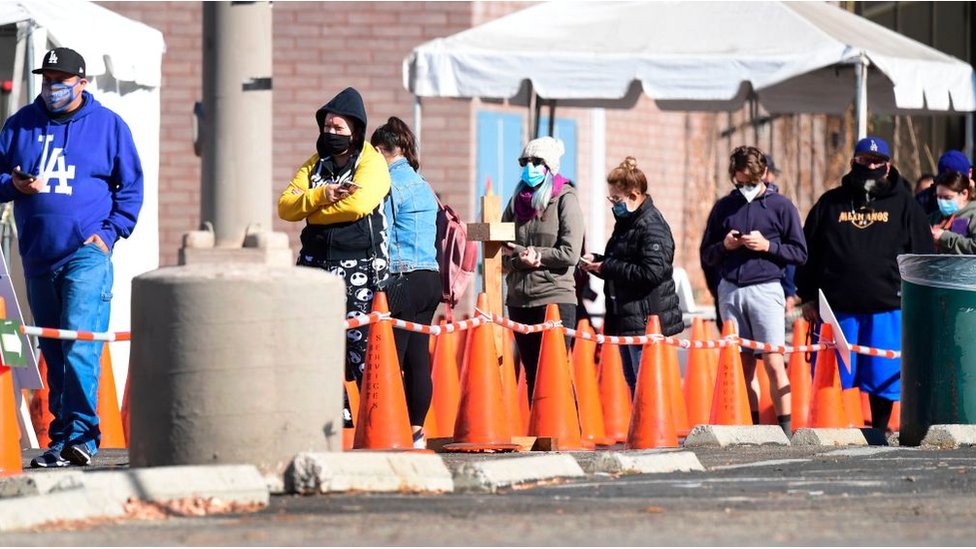
A California Covid testing siteIMAGE COPYRIGHTGETTY IMAGES
image captionA queue for testing in California

Mr Osterholm, who heads the infectious disease research centre at the University of Minnesota, said during the summer spike after the Labour Day national holiday, new cases rose to 32,000 a day.

"Now we're running in the 120- to 130,000 cases a day," he said. "Do not be at all surprised when we hit 200,000 cases a day."

The same day, US infectious disease chief Dr Anthony Fauci offered some hopeful news. He said the new Covid vaccine by Pfizer was expected to go through an emergency authorisation process in the next week or so. Human trials suggest it is 90% effective.

media captionHow close are we to Covid immunisation?

Dr Fauci told MSNBC: "I'm going to look at the data, but I trust Pfizer, I trust the [Food and Drug Administration]. These are colleagues of mine for decades, the career scientists."

Amid the ongoing outbreak, the US Centers for Disease Control and Prevention (CDC) has updated its research around masks, saying that wearing one not only protects others but also the person wearing the mask.

Previous guidance had rested on the idea that the main benefit of mask-wearing came from potentially stopping an infected person transmitting Covid to others.

The CDC referenced several studies, including one case where two Covid-positive hair stylists interacted with 139 clients - but of the 67 clients researchers tested, none developed an infection. The stylists and all clients had worn masks in the salon.

Another study looking into the outbreak aboard the UUS Theodore Roosevelt aircraft carrier found mask-wearing seemed to have reduced the risk of virus transmission by 70%, the CDC said.
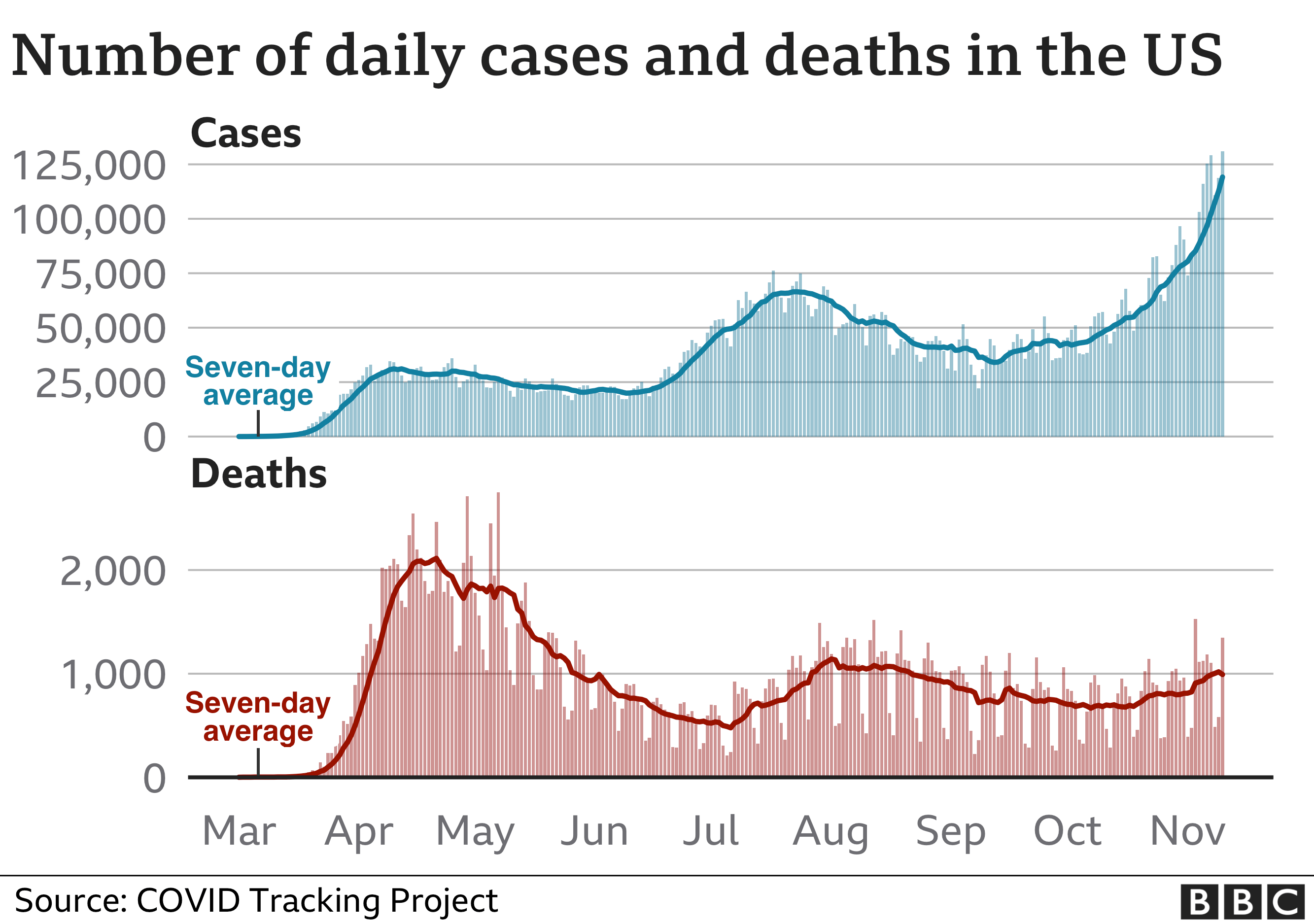
Chart showing cases and deaths in the US. Updated 11 Nov.

Covid: Brazil allows resumption of Chinese vaccine trial


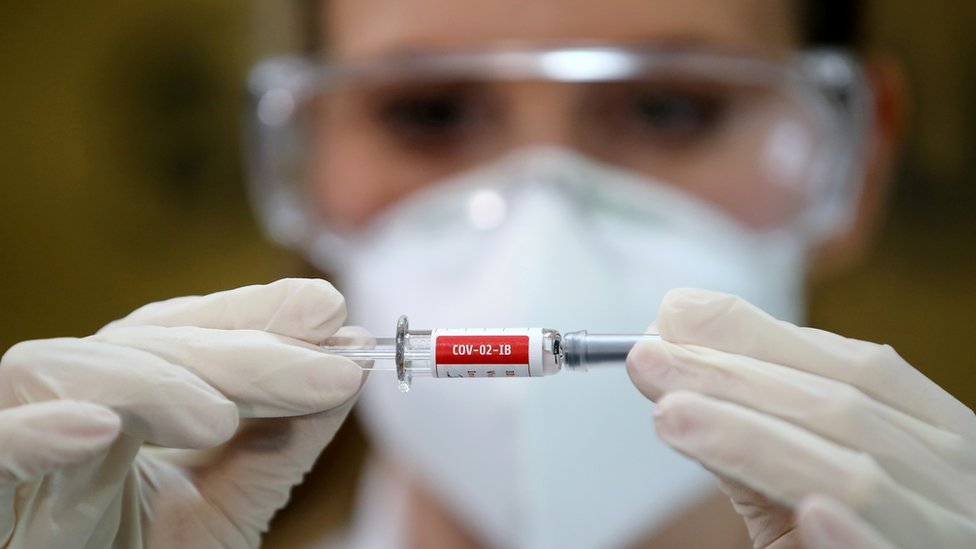
A nurse holds China's Sinovac vaccine at the Sao Lucas Hospital of the Pontifical Catholic University of Rio Grande do Sul (PUCRS), in Porto Alegre, Brazil August 8, 2020.IMAGE COPYRIGHTREUTERS
image captionAnvisa said it now had "sufficient information to allow vaccination to resume"

Brazil's health regulator has announced that the trial of a Chinese coronavirus vaccine can resume.

Anvisa suspended Brazil's trial of the vaccine two days ago, citing a "severe adverse incident" - reported to be the death of a volunteer.

The head of the institute conducting the trial said the death had no connection to the vaccine.

In a statement on Wednesday, Anvisa said it now had "sufficient information to allow vaccination to resume".

"It is important to clarify that a suspension does not necessarily mean that the product under investigation does not offer quality, safety or efficacy," it said.

President Jair Bolsonaro earlier declared the suspension a "victory".

He has long criticised the vaccine because of its Chinese links and said it would not be purchased by his country. He has also engaged in a political fight with the governor of São Paulo, João Doria, who has publicly backed the trial.

Mr Bolsonaro has not yet commented on Anvisa's announcement that the trial can resume.

The vaccine, developed by Chinese firm Sinovac Biotech, is one of several in final-stage testing globally. Sinovac says it is "confident in the safety of the vaccine".

Brazil has been one of the countries worst affected by coronavirus, recording more than 5.6m confirmed cases - the third highest tally in the world after the US and India - and nearly 163,000 deaths, according to data collated by Johns Hopkins University.

Why was the trial halted?

On Monday, Anvisa said it had "ruled to interrupt the clinical trial of the CoronaVac vaccine after a serious adverse incident".

It did not reveal what had happened, nor where it had taken place.

Dimas Covas, head of the Butantan institute conducting the trials, told local media that the trial's suspension was related to a death, but insisted that the death was not linked to the vaccine.

This was backed up by Jean Gorinchteyn, health secretary for the state of São Paulo, who told a news conference that the death was an "external event" that was not related to the vaccine.

Mr Covas said that there had been no adverse reactions to the vaccine, and that the decision to suspend the trial had caused "indignation".

Media reports say police are investigating the death as a suicide.

In its statement allowing the resumption of the trial on Wednesday, Anvisa said it now had more details on the nature of the "adverse incident".

It said its decision to suspend the trial "took into consideration the data known to the agency at the time".

A pause in a clinical trial is not unusual. In September, the UK paused trials for another Covid-19 vaccine after a participant had a suspected adverse reaction.

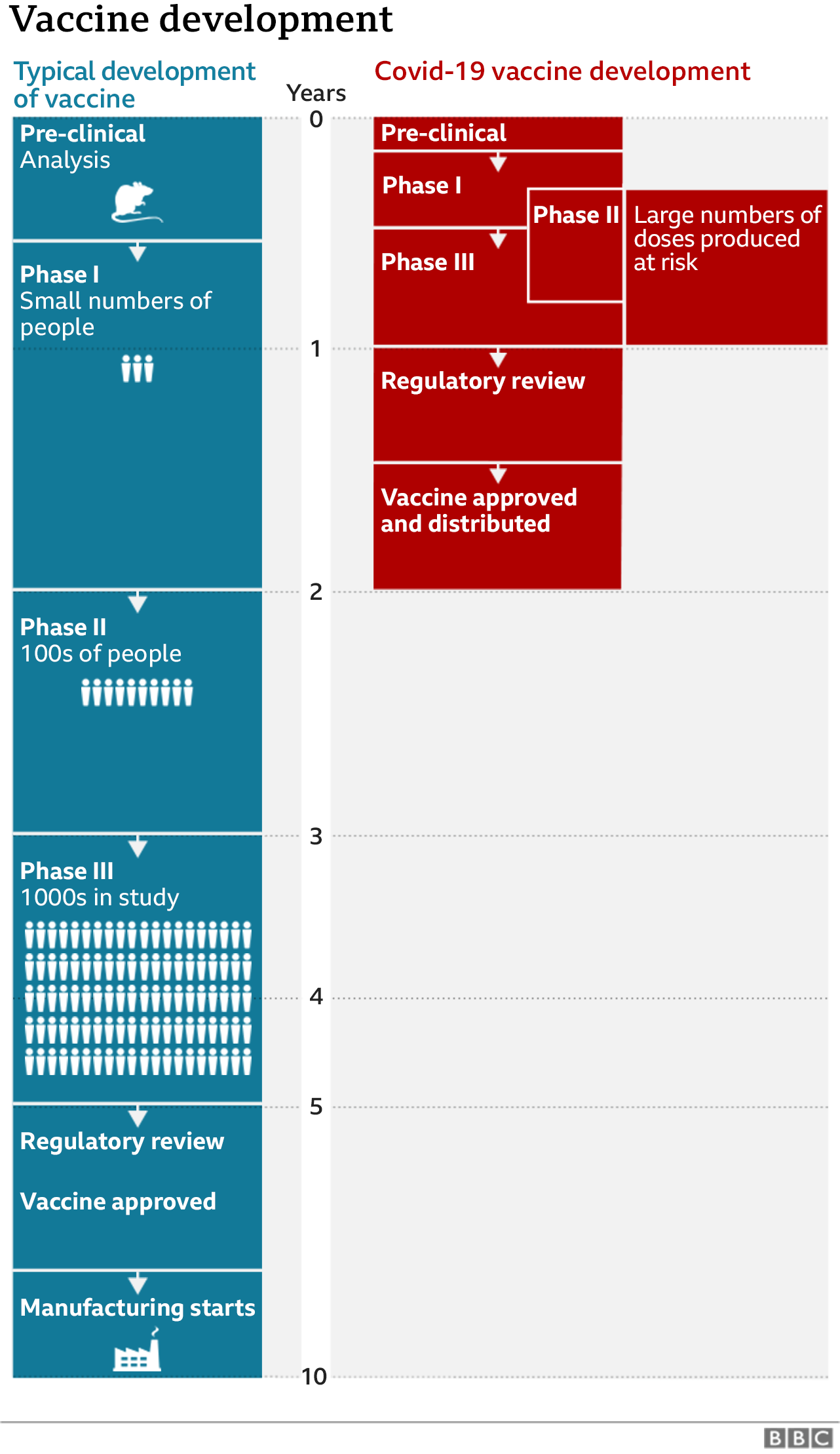
How the development of the Covid-19 vaccine is being fast-tracked

In October, a review into the death of a Brazilian volunteer involved in the AstraZeneca trial found no safety concerns. The BBC understands the volunteer did not receive the vaccine.

Brazil's president has been open about his preference for the vaccine being developed by AstraZeneca, saying his government would not buy a Chinese-made Covid-19 vaccine.

Hong Kong pro-democracy lawmakers resign after China ruling


media captionWu Chi-wai, Hong Kong pro-democracy lawmaker 'announces mass resignations'

All of Hong Kong's pro-democracy lawmakers have announced their resignation after Beijing forced the removal of four of their colleagues.

On Wednesday Beijing passed a resolution allowing the city's government to dismiss politicians deemed a threat to national security.

The opposition lawmakers then said they would leave in solidarity.

For the first time since Hong Kong was handed back to China in 1997 the body has almost no dissenting voices.

BBC China correspondent Stephen McDonnell says the legislature was already stacked in favour of the pro-Beijing camp.

The dismissal of the four legislators is viewed by many as the latest attempt by China to restrict Hong Kong's freedoms - something Beijing denies.

Democratic Party chairman Wu Chi-wai told reporters following the lawmakers' removal: "We can no longer tell the world that we still have 'one country, two systems', this declares its official death."

media captionPro-democracy lawmaker Claudio Mo: "They are forcing us to quit"

Hong Kong - formerly a British colony - was returned to China under the "one country, two systems" principle, which allowed it to retain more rights and freedoms than the mainland until 2047.

But in late June China passed a controversial, far-reaching national security law in the territory after years of pro-democracy and anti-Beijing protests, which reduced Hong Kong's autonomy and made it easier to punish demonstrators.

Why did the lawmakers resign?

The city's pro-democracy legislators had 19 seats in the 70-seat legislature. All those members have now left - either by resigning or by being dismissed.

The new resolution passed by China's National People's Congress Standing Committee on Wednesday says that lawmakers should be disqualified if they support Hong Kong independence, refuse to acknowledge China's sovereignty, ask foreign forces to interfere in the city's affairs or in other ways threaten national security.

media captionPro-Beijing lawmaker Michael Tien says China needed to take action to allow Hong Kong's legislature to function

It also allows the Hong Kong government to directly remove lawmakers without having to approach the courts.

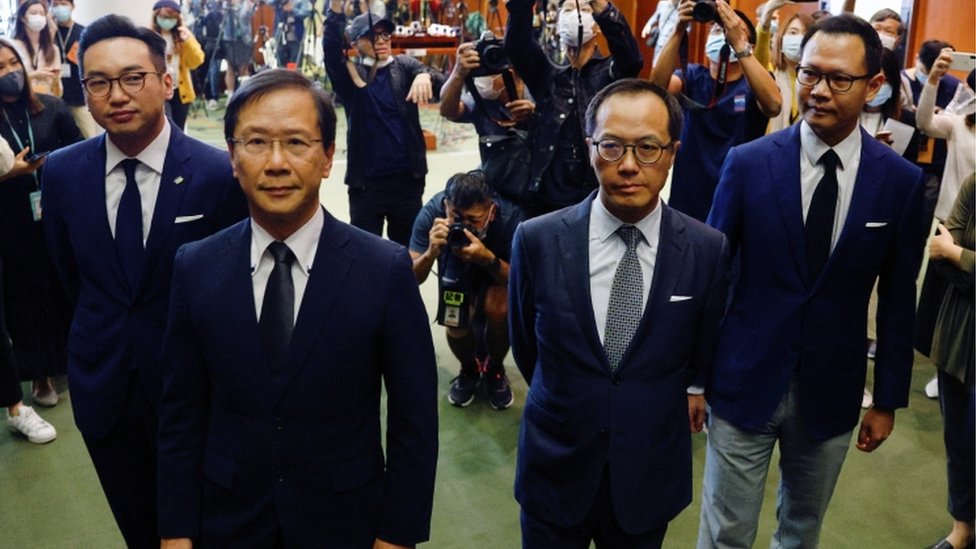
Moments after that resolution passed, four lawmakers - Alvin Yeung, Kwok Ka-ki and Dennis Kwok of the Civic Party and Kenneth Leung of the Professionals Guild - were dismissed.

All four of them are considered moderates and they have never supported Hong Kong independence.

"If observing due process and fighting for democracy can lead to being disqualified, it [disqualification] will be my honour," Dennis Kwok said.

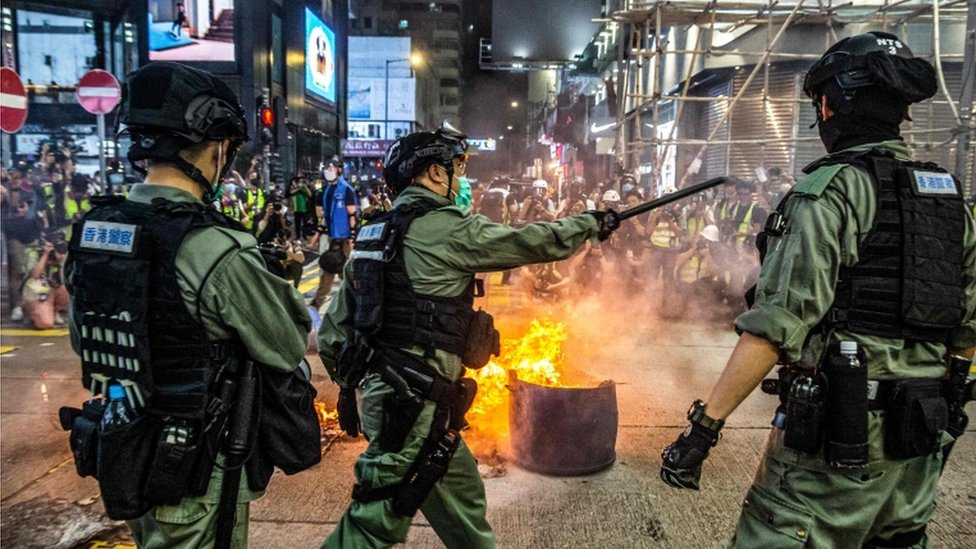
Police deter pro-democracy protesters from blocking roads in the Mong Kok district of Hong Kong on May 27, 2020IMAGE COPYRIGHTAFP
image captionCritics warn the law will shut down dissent

"We... will stand with our colleagues who are disqualified. We will resign en masse," Wu Chi-wai said. The 15 lawmakers' letter of resignation will be submitted on Thursday.

Chinese foreign ministry spokesman Wang Wenbin said the disqualification of the four lawmakers was "rational, reasonable and in line with the constitution and laws".

"This was a necessary requirement for adhering to and improving on 'one country, two systems,' implementing Hong Kong's Basic Law, as well as Hong Kong's National Security Law," he said at a news conference in Beijing.

But others have criticised the move. UK Foreign Secretary Dominic Raab called the Chinese resolution "a further assault on Hong Kong's high degree of autonomy and freedoms under the UK-China Joint Declaration".

"This campaign to harass, stifle and disqualify democratic opposition tarnishes China's international reputation and undermines Hong Kong's long-term stability."

Human rights organisation Amnesty International has also condemned the resolution. "Bulldozing through arbitrary decisions via the Chinese government makes a mockery of the rule of law," Asia-Pacific regional director Yamini Mishra said.

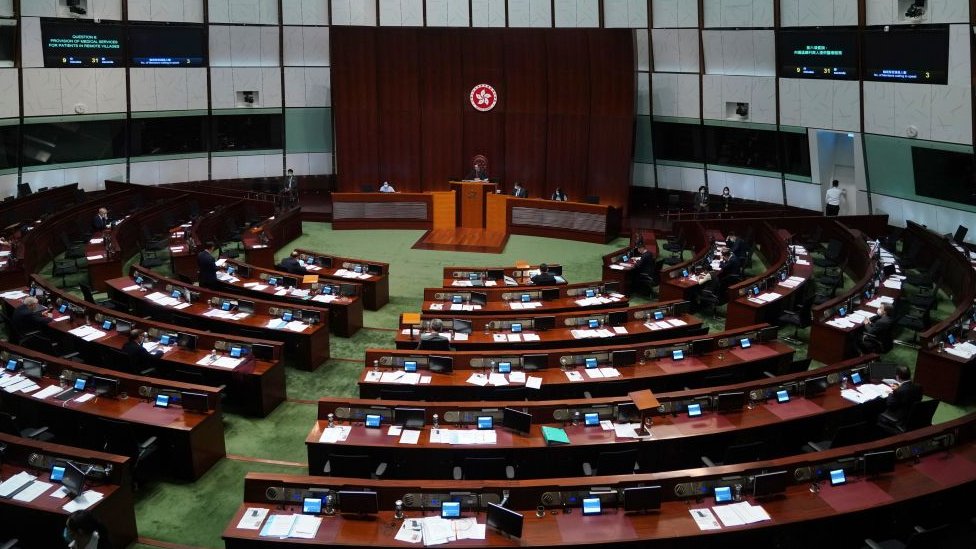
Legislators attend a Legislative Council (LegCo) meeting on November 4, 2020 in Hong Kong, China.IMAGE COPYRIGHTGETTY IMAGES
image captionChief Executive Carrie Lam said opinions in the legislature had to be expressed "in a responsible manner"

The territory's leader, Chief Executive Carrie Lam, is pro-Beijing and is supported by the central government there.

Speaking to the media, Ms Lam said the four council members who were disqualified had already failed to meet the requirements to stand in the now postponed elections next year.

She added that although she "welcomes diverse opinions in the Legislative Council" these had to be expressed "in a responsible manner".

South China Morning Post newspaper quoted Ms Lam as saying no by-elections would be held in the four now vacant seats as legislative elections were only nine months away.

Analysis box by Stephen McDonell, China correspondent

The Chinese government and its surrogates in Carrie Lam's administration have - in recent times - used specific problems as a series of excuses to introduce wholesale, Draconian changes which will remain in place long after whatever hurdle it is has been cleared.

In this case, four legislators had, controversially, been ruled ineligible for the next Legislative Council election.

However, because the term of the current legislature had been extended for a year, due to a delayed vote, they had been able to remain in their existing positions.

Alvin Yeung Ngok-kiu, Kwok Ka-ki, Kenneth Leung and Dennis KwokIMAGE COPYRIGHTREUTERS
image captionThe four lawmakers after they were removed

Carrie Lam wanted them gone straight away so she says she asked Beijing to introduce a new law enabling their immediate dismissal.

In reality, who knows whether Hong Kong's leader requested this move or was told it was going to happen by the Communist Party's senior leadership?

Either way, now the city government has been empowered to remove any pro-democracy politician who is seen to have acted with insufficient loyalty to the motherland in the future.

Crucially, the courts can be bypassed under the new rules and, now that the Hong Kong government has said that the concept of the separation of powers has never actually applied in the city, the executive branch is able to dismiss members of the legislature and their view is that this is not really anything to worry about.

Presentational grey line

What's been happening in Hong Kong?

As a Special Administrative Region, Hong Kong was to have its own legal system, multiple political parties, and rights including freedom of assembly and free speech.

But the new security law for the city passed in response to months of pro-democracy protests criminalised "secession, subversion and collusion with foreign forces".

Beijing said the law will return stability to the territory, but critics said it effectively curtails freedom of speech and protest.

After the introduction of the security law the UK offered Hong Kong residents still holding British National Overseas (BNO) status a route to British citizenship.

Around 300,000 people currently hold BNO passports, while an estimated 2.9 million people born before the handover are eligible for one.

China last month strongly criticised the UK in response, telling London to "immediately correct its mistakes".

RAF Lossiemouth jets scrambled to Russian aircraft

  RAF jets were scrambled to intercept four Russian military aircraft to the north of Scotland. Typhoons from RAF Lossiemouth in Moray and a...